

China+1: ASEAN Becomes the New Multimodal Air Hub
English - Ngày đăng : 08:30, 29/09/2025
FreightWaves’ analyses indicate that Southeast Asia has significant “absorption” capacity thanks to years of infrastructure investment; yet the value chain remains tightly anchored to China’s component and semi-finished-goods networks. As a result, flows are increasingly multi-origin and multi-leg, demanding more sophisticated orchestration.
Three forces pushing ASEAN to the front line
Intra-regional demand is rising. UPS has just added intra-Asia air capacity as regional demand heats up, while China–US volumes cool—clearly signaling a shift in focus from long-haul trans-Pacific lanes to an expanded pan-Asian network.
Europe–Asia lift enables “multi-gateway.” In the first week of 2025, cargo airlines added services on Europe–Asia and Middle East routes, giving Southeast Asian shippers more options to split volumes—allocating across several gateways and contracts—to reduce seasonal and congestion risks.
E-commerce is reshaping demand patterns. Entering 2025, the e-commerce market is no longer as “red-hot” as in 2024: FreightWaves updates note slower growth expectations and recurring “inflate-deflate” swings driven by tax and control policies. Shippers are therefore prioritizing flexibility and schedule transparency over “single-gateway convenience.”
Multi-node networks, interwoven value chains
The essence of China+1 is not an exodus from China, but adding production-and-logistics “legs” in ASEAN to reduce risk while preserving scale advantages and the established ecosystem. FreightWaves underscores a “repositioning—but-complex” picture: many steps still return to China for completion before being shipped to the EU/US. This creates interlaced corridors: components move overland from Guangdong to Northern Vietnam or Thailand for finishing in industrial zones, then proceed by ocean or sea-air via Middle Eastern/Northeast Asian hubs before flying onward to Europe or the US.
On the policy front, changes to taxation—especially for cross-border parcels into the US—have knocked some China-origin flows off rhythm, prompting operators to re-optimize networks and volumes and, indirectly, elevating the role of ASEAN gateways. In the field, some carriers and shippers have reduced trans-Pacific frequency, ramping up allocations to alternative corridors or other destination markets, which has sharply increased demand in ASEAN for flexible capacity “grabs.”
ASEAN: from “secondary stop” to “core node”
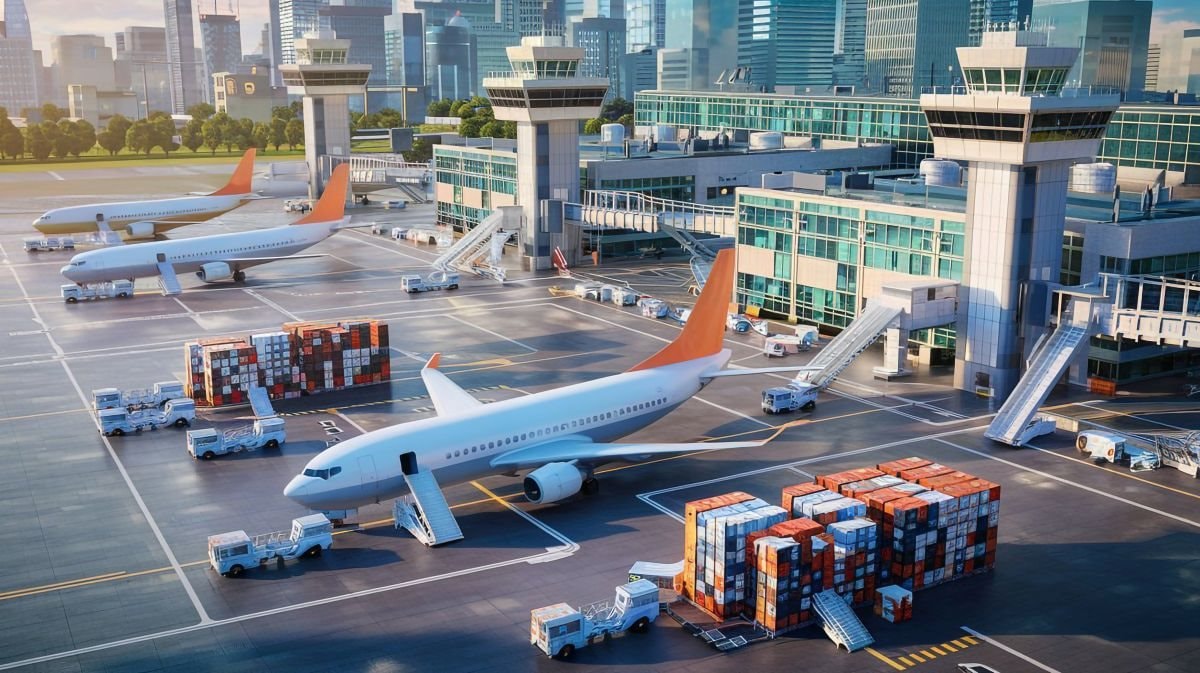
The 2025 inflection lies in regional hubs being folded into deliberate “multi-gateway” strategies: cargo airports in Vietnam, Thailand, Singapore, Malaysia, and others—together with warehousing, screening, and ground-handling ecosystems—are being used as platforms to spread risk. New lift on the Europe–Asia axis gives companies better bargaining leverage: instead of locking into a single corridor, shippers can “stack” contracts by season, product family, and gateway. FreightWaves’ early-2025 market reads show shippers shifting decisively to “proactive flexibility”: willing to change origin/destination points and split lots to avoid chokepoints.
That said, ASEAN’s foundations are still “thin” in places: procedural standardization, inter-agency data synchronization, and uniformity of ground processes vary widely. Leaders are accelerating E-freight/E-AWB adoption, smart screening, and binding ground SLAs; slower links will become new “bottlenecks” when volumes concentrate.
Sea-air/road-air: hybrid lanes that win on lead time and agility
China+1 has made hybrid lanes highly useful. For seasonal fashion, consumer electronics, and high-value components, sea-air via the Middle East or Northeast Asia can trim lead time by 30–50% versus all-ocean while costing only a fraction of pure air. As UPS, FedEx, all-cargo carriers, and belly networks within Asia rebalance lift, ASEAN gains more “anchor points” to stitch sea-air/road-air on a weekly cadence—rather than monthly—especially in the run-up to Lunar New Year and major retail campaigns.
Tax–trade variables and the “coolness” of the recovery
Both IATA and FreightWaves note: 2025 is a year of slower growth but not a reversal. Firms can still secure capacity and gateways, but should not expect prolonged “fireworks.” US cross-border parcel policies are curbing demand in some segments and forcing carriers to reroute; at the same time, the cost of capital and consumer spending remain sensitive, producing hard-to-predict “inflate–deflate” patches within quarters. Strategy in ASEAN must therefore pivot on contract discipline + gateway flexibility, rather than one-way bets.
From “riding along” to “routing by design”
Vietnam’s opportunity is not just labor cost, but smart routing. That means situating plants near airports/ports, linking them with supporting logistics zones that include GDP-compliant cold storage for pharma-biotech, and deploying end-to-end digital documentation platforms. For electronics–fashion–temperature-controlled pharma, a workable formula is a mixed-contract approach: lock 60–80% of volume under contract (to secure costs) while reserving 20–40% for flexibility (spot/mini-tenders) across both ocean and air; in parallel, pre-design 1–2 sea-air lanes via high-capacity hubs in the Middle East/Northeast Asia, ready to activate when ocean lead times stretch.
In tandem, pursue multi-gateway and split-volume tactics. Added Europe–Asia lift at the start of the year allows Vietnamese exporters to spread loads across more air gateways, reducing dependence on a single schedule. Contracts should include flex-window provisions to change dates/gateways without heavy penalties, together with OTP (on-time performance) KPIs that bind refunds/compensation for delays—a model global retailers increasingly treat as a purchasing standard.
Finally, adopt digital standards: E-AWB/E-freight and data connectivity with customs and airports to shorten ground time. This is not only about speed but also an “entry condition” for long-term international contracts—especially in pharma-biotech.
- Sign framework agreements with 2–3 carriers/forwarders to secure lift, embed flex-windows and transparent OTP terms. The 2025 market bias favors splitting volumes and changing origin/destination points as conditions evolve.
- Design a “held-in-reserve” sea-air lane for lead-time-critical SKUs: lock a route through a high-capacity hub, define ground SLAs and packaging/ULD standards, and trigger the lane when lead-time slippage breaches thresholds.
- Digitize tracking and standardize E-AWB to cut ground time and improve gateway agility; this is being strongly pushed by IATA and airlines as air-cargo growth in 2025 slows, yet remains “warm.”
China+1 in 2025 is not a sudden pivot but a careful “re-weaving” of the web: more distributed production and logistics, more branched transport corridors, and tighter work on contracts, gateways, and digitization. With accumulated infrastructure, ASEAN is evolving from a “secondary point” into a core node of the new air-and-multimodal routes. For Vietnamese enterprises, the upside lies in proactive routing: mixed contracting, multi-gateway setups, standardized sea-air solutions, and a chain-wide digital backbone. As policy and geopolitical variables continue to intertwine, that proactivity will convert the China+1 advantage into a durable competitive lever for the period ahead.