

Zero-Emission Trucks + AI: a practical road for road freight
English - Ngày đăng : 08:00, 12/11/2025
.jpg)
From BEV/H₂ to a technology portfolio
Zero-emission trucks work best on short/medium corridors with steady demand. Battery-electric suits fixed stops and night charging; hydrogen fits heavy or long-haul duty and fast turns. Rather than a single bet, build a portfolio: BEV for 150–250 km/day lanes; H₂ for >26-ton cross-province routes; AC at depots plus a few DC fast chargers at bottlenecks to handle exceptions.
Constraints include payload penalties from battery mass, fragmented connector standards and limited depot capacity at peak hours. Design backwards from payload, time windows and warehouse cadence, then pick the truck/charger mix and stop plan. Avoid jumping to volatile long lanes on day one; start with a depot cluster, short lanes and recurring freight, measure SOC, kWh/km, dwell and shift delays, then expand checkerboard-style to build your own learning curve for consumption, charging and TCO.
AI for quick wins - route, load and idle optimization
AI closes the execution gap in three layers. Demand: intraday forecasts to align shifts and move charging to off-peak windows. Operations: geo-temporal order clustering, stop sequencing to cut empty miles, automatic SOC buffers for gradients and highways. Infrastructure: depot power allocation and mid-route DC top-ups only when needed.
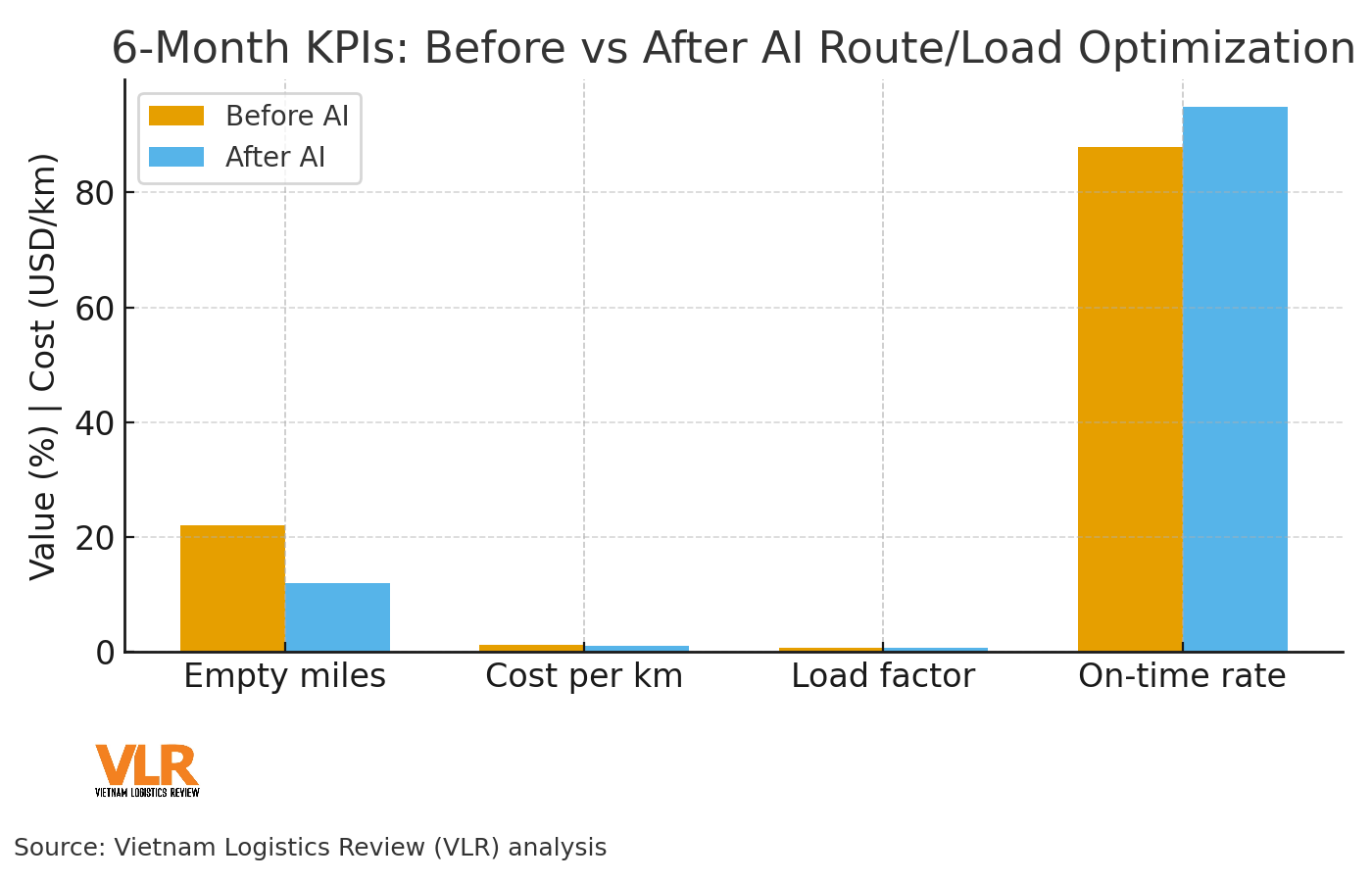
Within 3–6 months, typical outcomes include empty miles down 8–12 percentage points, load factor up 10–15 points, on-time performance up 5–8 points, and cost per km down thanks to off-peak electricity and fewer cascading delays. Just as important, AI enforces data discipline so every dispatch, charge and shift decision is auditable for ESG. Robust exception handling—weather, traffic, charger outages—lets the system suggest plan-B options such as swapping shifts, charge points or BEV/H₂ assets.
24-month rollout: pilot → scale
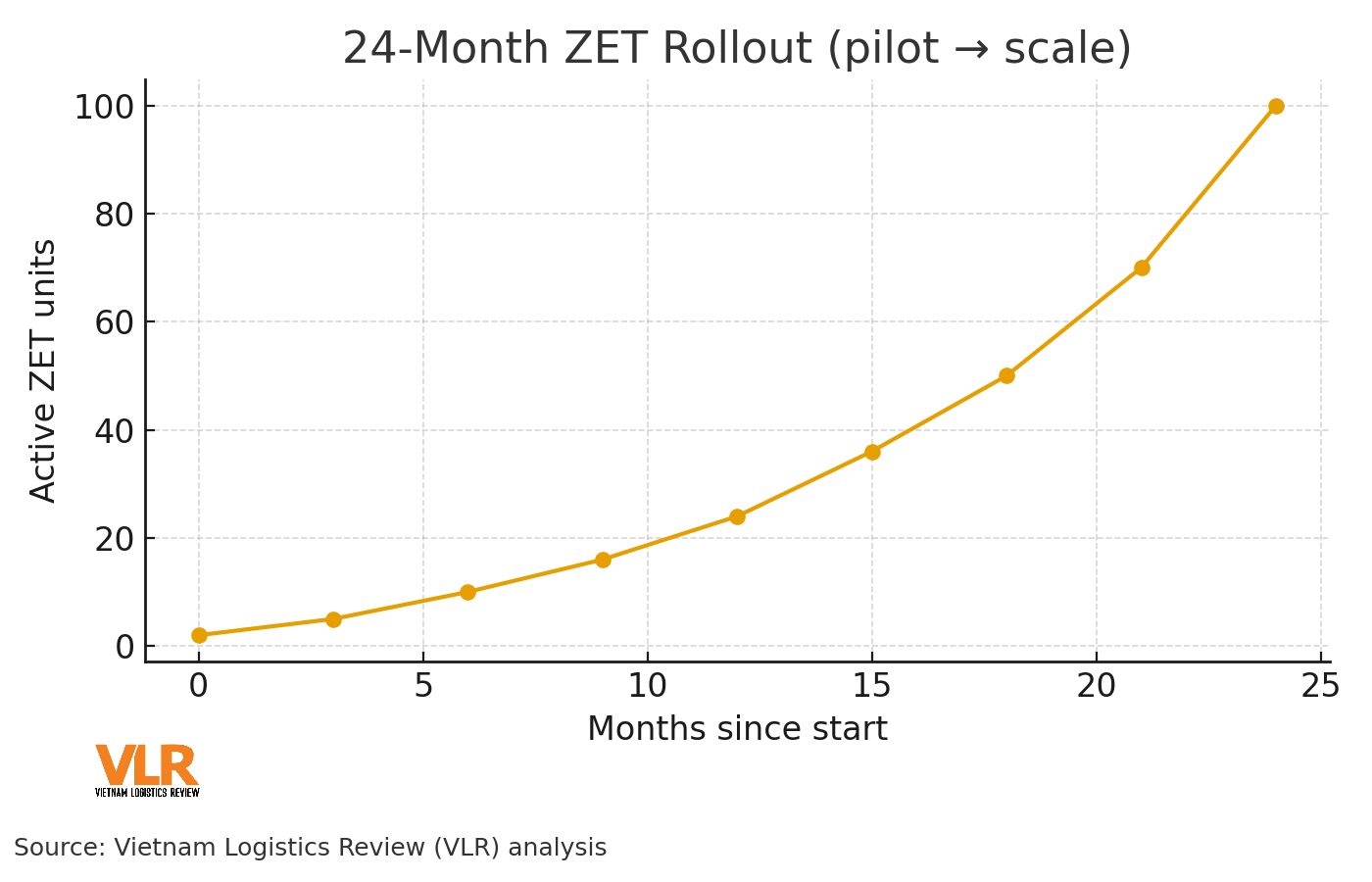
Months 0–3: pilot 2–5 BEVs on 150–250 km/day lanes, night AC charging plus one DC fast plug at the hub. Track monthly KPIs: empty miles, cost/km (energy plus battery depreciation), load factor, on-time, CO₂e/ton-km, share of off-peak charging.
Months 4–9: expand checkerboard-style once KPIs hold for two consecutive months; refine order clustering by delivery windows; trial H₂ for heavy or long-haul routes. Start dynamic TCO by netting AI savings (empty miles, labour hours, brake/tyre wear) against infra CAPEX/OPEX.
Months 10–24: standardize shift–charge–maintenance, apply truck-as-a-service to part of the fleet to lower upfront investment, integrate energy payments and ESG reporting, and prepare verifiable abatement data for customer contracts. The goal is modular fleet growth while keeping cost and CO₂e trending down with volume.
Target the 150–250 km/day sweet spot with steady flows. Use AI to build shift–night-charge cycles; a few DC plugs at the hub suffice. Create a monthly TCO profile—cost/km, CO₂e/ton-km, on-time—and scale vehicles and add satellite lanes only after two quarters at target KPIs. Avoid leaping to volatile long lanes before the data matures.
.jpg)
Do not fully own on day one. Try a truck-as-a-service model: the provider covers batteries, charging and maintenance; you pay an operational rental per km or throughput. This trims upfront capital, shortens payback and preserves flexibility as technology evolves; include energy-efficiency performance clauses to share risk.
While infrastructure is uneven and standards still evolve, combining zero-emission trucks with data-driven optimization lets operators achieve early, durable wins. Success hinges less on the most expensive vehicle or the largest charger than on orchestrating flows: the right orders clustered, the right charging windows, the right shift assignments and a prepared contingency playbook. Maintain monthly discipline cost/km, CO₂e/ton-km, on-time, off-peak charging share and wire these into a dynamic TCO so expansion decisions are evidence-based. Electrification thus becomes an efficiency lever rather than a cost burden. As batteries, hydrogen, grids and charging standards advance, a validated operational dataset and mature algorithms provide the springboard to confident scale-out, taking you from a few showcase lanes to a broader network and translating net-zero ambition into a predictable, financeable business pathway.