

Green Logistics and the Road to Net Zero: From National Pledges to Supply Chain Action
English - Ngày đăng : 07:58, 26/01/2026
From long-haul trucking, coastal shipping and barges to warehouses, logistics parks and last-mile delivery, each link in the chain leaves a visible carbon footprint. The key question is how to turn “green logistics” from a slogan into a concrete, workable roadmap for Vietnamese companies.
From Net Zero commitments to decarbonisation pressure in logistics
By committing to Net Zero, Vietnam has effectively signalled that all sectors must begin quantifying and reducing emissions, not just focusing on volume and revenue growth. Logistics is high on the list because it concentrates the bulk of trucks, container fleets, inland waterway vessels and large warehouse footprints consuming substantial amounts of fuel and electricity.
At the international level, regulations in maritime transport, environmental provisions in next-generation free trade agreements and supply chain emission disclosure requirements from multinational corporations are putting growing pressure on logistics providers. Many global shippers are already incorporating environmental criteria into their logistics procurement scorecards: favouring partners with decarbonisation plans, ESG reporting, and clear roadmaps to cleaner fleets and operations.
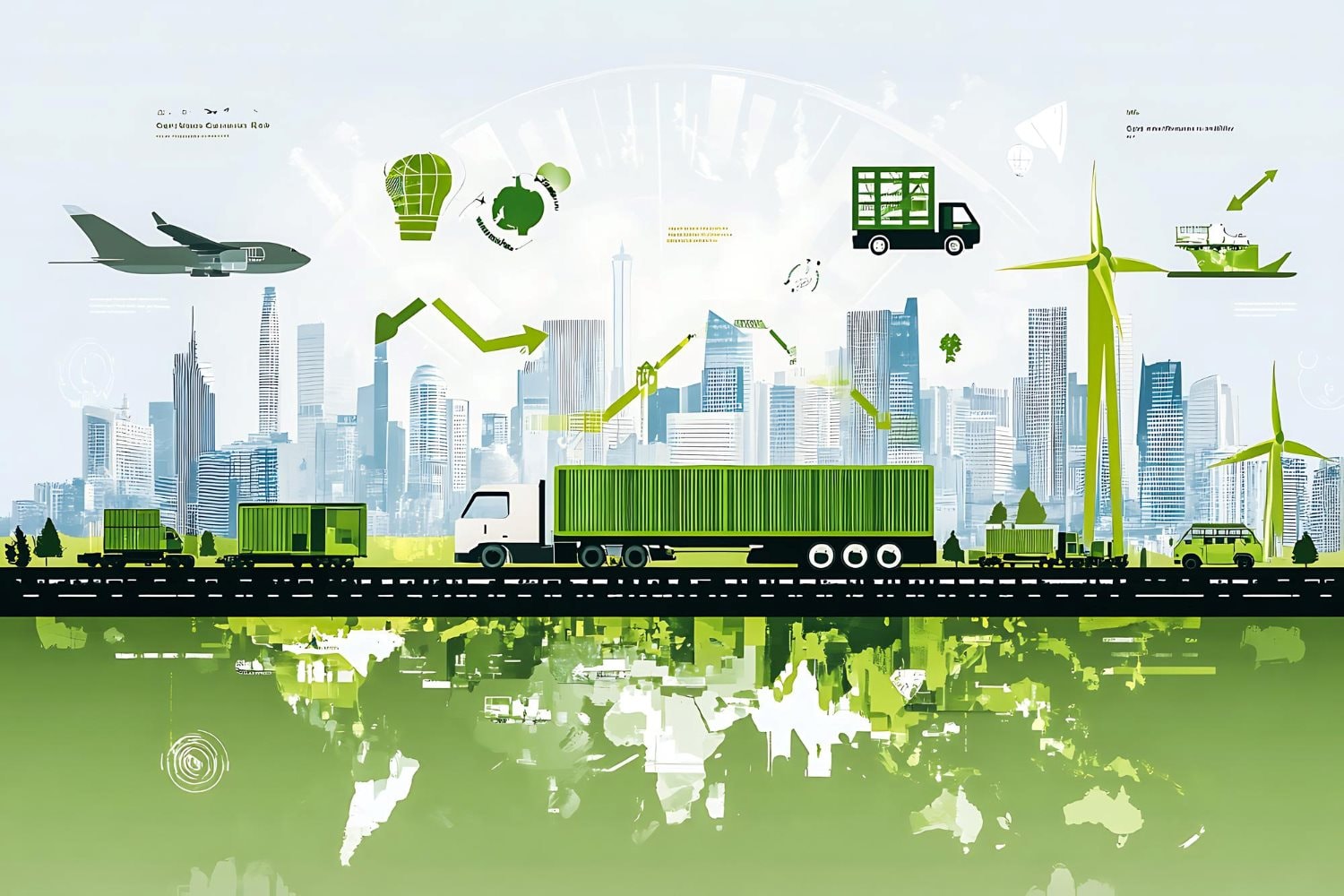
Domestically, major cities are exploring measures to restrict polluting vehicles in central districts and promote greener urban logistics. All of this shows that green logistics is no longer a voluntary “nice-to-have”; it is becoming a prerequisite for staying in future supply chains. The real questions are no longer “whether to act” but “where to start” and “how to balance cost and benefit”.
Green logistics: more than cleaner fuels, it is about whole-chain optimisation
A common misconception is that green logistics is mainly about replacing old vehicles with new ones, switching to cleaner fuels or putting solar panels on warehouse roofs. In reality, these are only visible parts of a much larger picture. The core of green logistics lies in reducing waste across the chain – from empty miles and idle time to poor network design and inefficient use of infrastructure.
In road transport, optimised routing, higher load factors, reduced empty backhauls and better fleet management can cut fuel consumption significantly, sometimes more than simply upgrading to newer vehicles. Similarly, shifting appropriate volumes from road to rail or inland waterways can lower both costs and emissions per tonne-kilometre, provided that services are reliable and integrated into wider supply chain planning.
In warehousing, smarter building design – with natural light and ventilation, energy-efficient lighting and cooling, and well-designed internal flows – can reduce energy consumption while improving productivity. Many leading operators now use recycled materials where possible, install rooftop solar, and deploy energy management systems (EMS) to monitor and adjust power use by zone and time of day.
Equally important is how logistics companies work with customers. When they proactively advise shippers on order consolidation, more flexible delivery windows, and “green slots” that align with optimised transport routes, providers can reduce emissions and cut costs while differentiating their services. Green logistics, in that sense, is the outcome of a series of adjustments in processes, technology and collaboration – not just a handful of “green” capex projects for marketing purposes.
A practical roadmap for Vietnamese companies: measure – optimise – invest – connect
To avoid being overwhelmed by the broad concept of Net Zero, Vietnamese logistics providers can think in terms of a four-step journey. The first step is measurement. You cannot manage what you do not measure. Companies need to build a baseline emission profile: fuel consumption by vehicle type, electricity usage by facility, handled volumes, transport distances, empty mileage. International greenhouse gas accounting standards can be adapted to local realities and data availability.
The second step is to optimise what already exists. Before committing to large investments, companies should exhaust “no-regret” measures such as route redesign, better load planning, improved yard and dock operations, driver eco-driving training, preventive maintenance, and smarter inventory and flow management. These steps often yield quick wins and free up financial capacity for later investments.
The third step is targeted investment in green technologies and infrastructure: gradually renewing fleets to higher emission standards, piloting electric or alternative-fuel vehicles on short routes, installing rooftop solar and energy management systems in warehouses, and using IoT solutions to monitor fuel and power consumption in real time. Project selection should be based on lifecycle analysis, not fashion, to ensure long-term value.

The fourth step is to connect with the broader ecosystem: joining national and international green logistics initiatives; collaborating with ports, industrial zones, carriers and technology partners to pilot new models – from green corridors and multimodal routes to shared emission data platforms. When companies act as part of a Net Zero ecosystem rather than in isolation, both costs and risks are shared, while benefits – in branding and business opportunity – can multiply.
Green logistics is not a PR campaign; it is a long-term operational strategy. When companies start by measuring emissions, then optimise existing operations before investing and plugging into a wider ecosystem, “Net Zero” ceases to be a distant figure in a policy paper and becomes a series of everyday decisions: which route to run, which mode to use, where to store, whom to partner with. Step by step, these decisions add up to a real shift in how supply chains impact the environment.
On the road to Net Zero, logistics is both a challenge and an opportunity for Vietnam. If green logistics is seen purely as a cost burden, local providers will always be a step behind shifting market expectations. But if it is viewed as a chance to redesign networks, upgrade technology and innovate service models, Vietnamese logistics companies can build a new layer of competitive advantage – not just on price, but on their ability to deliver efficient and environmentally responsible supply chains. In that future, every kilometre transported and every square metre of warehouse space will carry not only goods, but also a tangible commitment to sustainable development.