

When cost is no longer king in supply chains
English - Ngày đăng : 08:00, 11/03/2026
Globalization is shifting from optimization to repricing risk
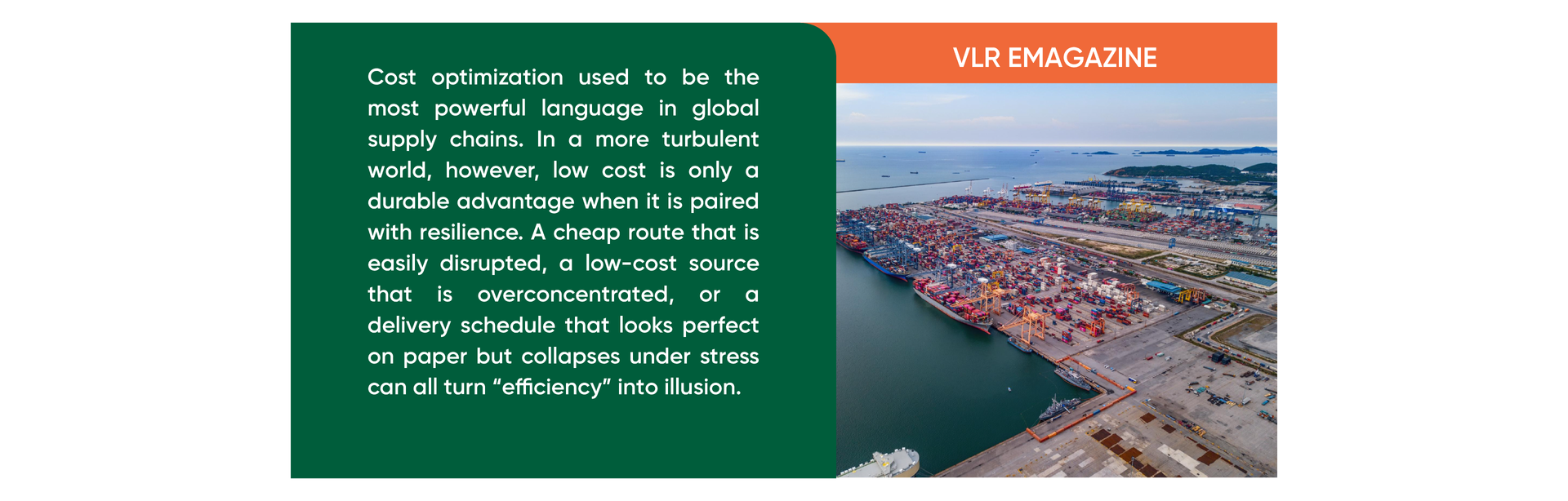
The old model is under pressure because the world no longer operates in the stable environment that once made extreme efficiency possible. UNCTAD shows that rerouting container ships away from the Red Sea and around the Cape of Good Hope imposed multiple layers of cost at once: more fuel, more charter expense, higher insurance exposure, greater emissions burden and more congestion at alternative nodes. The same report notes that rerouting raised global container ship demand by about 12% by mid-2024. In simple terms, the system had to consume more capacity to do the same work. That is the moment at which risk gets repriced in real money.
In the arguing that the 1990s and 2000s were decades of cost optimization, while the 2020s are becoming the decade of supply-chain resilience. This is not just academic vocabulary. It is reshaping how firms model profitability, how multinationals design supply networks and how states increasingly view logistics infrastructure as part of economic security. In a world where geopolitical risk is more persistent, today’s cheap option may prove to be tomorrow’s expensive mistake if it is built on a brittle structure.
The real cost of slowing down
One of the most common mistakes in supply-chain management is underestimating the price of time extension. A delay of seven to ten extra days at sea is not just a scheduling inconvenience. It means inventory spends longer in transit, working capital stays tied up, safety-stock needs rise, production plans require adjustment and seasonal sales windows become harder to hit. In many sectors, even small timing distortions can upset the alignment between suppliers, manufacturers and distributors. That is why slower logistics almost always becomes more expensive logistics, even when the full price is not obvious in the initial freight quote.
From “just in time” to “just in case”
The most important shift today is philosophical. In the old model, just-in-time operations symbolized lean excellence: minimal inventories and deep faith that global transport would remain fluid. In the new model, more companies are accepting just-in-case logic: keeping strategic stock at selected points, diversifying shipping routes, spreading manufacturing footprints, reducing dependence on single nodes and investing more in early risk visibility. The uploaded file anticipated this shift well, noting that more firms are moving from pure cost optimization toward risk management.
The broader global risk context reinforces that change. The World Economic Forum ranks geoeconomic confrontation as the leading short-term global risk for 2026, which means firms increasingly operate in an environment shaped by sanctions, fragmentation, protectionism, regional conflict and strategic rivalry. In that setting, companies that chase only the lowest freight cost are likely to become prisoners of the old model. By contrast, firms that redefine efficiency in more resilient terms stand a better chance of protecting customers, margins and reliability through turbulence.
Firms need to recalculate profitability
One major consequence is that companies can no longer treat logistics simply as a cost centre to be squeezed. In many industries, logistics is becoming a strategic variable that determines customer retention, cash-cycle speed and the durability of growth. Simply delivering more reliably than competitors during disruption can create a significant market-share advantage. Profitability therefore has to be recalculated to include disruption costs, opportunity loss, reputational exposure and recovery expense - not just freight charges.
Conclusion
When cost is no longer king, global supply chains are forced into a new efficiency standard. That standard does not reject optimization, but it requires optimization to sit under a broader architecture of risk management, diversification and resilience. In the 2020s, the companies that can deliver more reliably in unstable conditions will hold the more meaningful advantage. That may be the most profound lesson the world is now relearning through Hormuz, the Red Sea and Suez.
References: By Quyen Nguyen, “Hormuz Is Not a New Shock”
Source: www.cel-consulting.com