
Vietnam and the endurance test of global logistics
English - Ngày đăng : 08:00, 12/03/2026
High trade openness means high sensitivity
World Bank WITS data show that Vietnam’s exports of goods and services equal 86.47% of GDP, while imports equal 78.35%. This is clear evidence of how deeply the country is integrated into international trade flows. High openness has been a major foundation for growth, industrialization and FDI attraction. But the other side of the equation is heightened sensitivity to external disruption. When freight rates rise, when oil and gas markets shift, when vessel rotations slow or feeder schedules lose rhythm, Vietnamese firms have limited insulation. Shocks that appear geographically distant can show up very quickly in quotations, lead times and margins.
That is why for a deeply trade-linked economy like Vietnam, global chokepoints cannot be viewed as somebody else’s problem. Hormuz may not be a major direct export destination for Vietnam, yet any disturbance to global energy routes can affect fuel pricing, shipping sentiment and transport costs. Suez and the Red Sea may be thousands of kilometres away, but when Asia - Europe services are rerouted, schedules, empty-container positioning, hub operations and global freight benchmarks all feel the pressure. In modern trade, geography no longer provides much protection from systemic economic spillover.
Indirect effects are often larger than direct exposure
Vietnam’s biggest vulnerability does not lie in direct trade with conflict zones, but in indirect exposure through the global network structure itself. This is the right lens. Vietnamese cargo heading to the United States, Europe, Japan and other major markets operates inside the same maritime ecosystem of shipping capacity, energy prices and global schedules as everyone else. When a chokepoint is disrupted, Vietnamese businesses are pulled into the same higher-cost, higher-uncertainty environment even if they are not selling directly into the crisis area.
The Red Sea is the clearest example. When UNCTAD recorded sharp declines in Suez traffic and a surge in Cape of Good Hope rerouting, the impact did not stop at Europe-bound services. Longer routes reduced effective fleet productivity, lifted container ship demand, pressured freight rates, strained transshipment nodes and undermined schedule reliability on connected routes. For a strong exporting nation like Vietnam, it takes only one major destination market experiencing longer transit time, or a handful of disrupted transshipment services, for pressure to feed back into factories, warehouses, delivery contracts and domestic financial planning.
Opportunity will not come from low cost alone
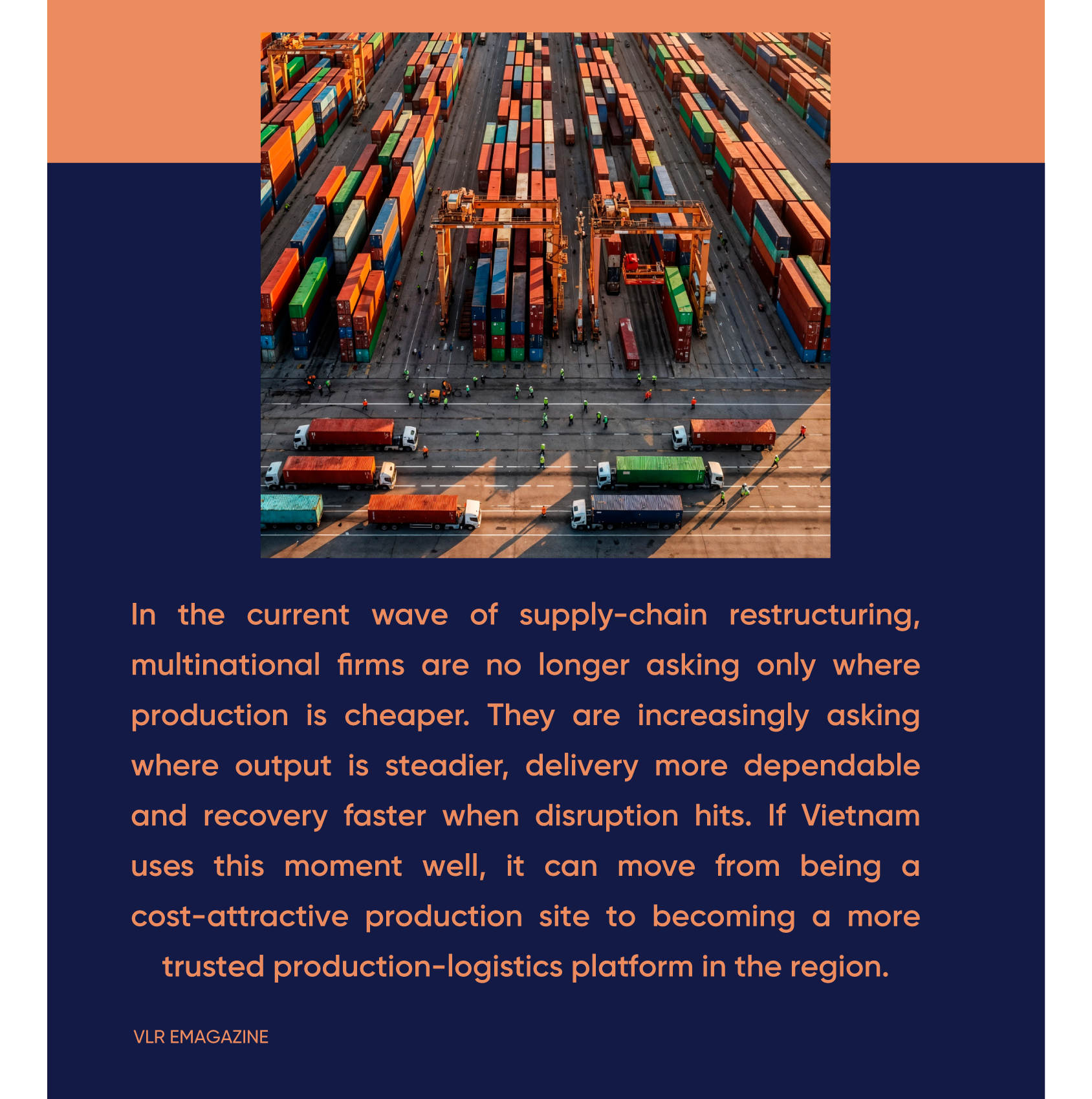
The current fragmentation also opens a strategic opportunity for Vietnam. As multinational firms redesign supply chains, Southeast Asia is gaining appeal as part of diversification strategies. The uploaded document suggests that production hubs in the region, including Vietnam, are becoming more important in maintaining the stability of regional trade networks. Yet that advantage will not be secured automatically through labor cost or location alone. In the new era, investors and buyers are increasingly asking a bigger question: where is production more dependable when the world becomes unstable?
That question demands a deeper upgrade of Vietnam’s logistics system. Ports must offer not just capacity but strong hinterland connectivity. Transport must deliver not only competitive pricing but rhythm under stress. Digital transformation must move beyond slogans into real visibility, routing intelligence and operational transparency. If Vietnam remains only an attractive assembly base with reasonable costs, it can still be substituted when cost equations shift. But if Vietnam strengthens logistics reliability and execution quality, its role in the regional production map becomes more durable and more strategic.
Vietnam must move from participating in chains to upgrading its role
A strong export economy cannot be satisfied merely with being present in global supply chains. The next phase requires Vietnam to move from participation to upgrading position. That means higher value-added activity, greater logistics reliability, stronger service capability, better shock absorption and less excessive dependence on single nodes. In a world where geoeconomic confrontation is now considered a top short-term global risk, the countries that can demonstrate more resilient delivery performance will enjoy a stronger hand in retaining investors and orders.
Conclusion
Hormuz, Suez and the Red Sea are not just names associated with instability. For Vietnam, they are practical tests of endurance for an open economy. They remind us that export-led growth is only as durable as the logistics system that supports it. In the next phase of global trade, countries that do not only produce well but also deliver reliably through crisis will move to higher ground in global supply chains. That is the challenge facing Vietnam now and also its opportunity.
References: By Quyen Nguyen, “Hormuz Is Not a New Shock”
Source: www.cel-consulting.com