
Forced-labor tariffs: "A new gatekeeper" to the U.S. market
English - Ngày đăng : 10:34, 24/07/2026
Vietnam falls into the group subject to a 12.5% tariff, except for exempted products. Effective July 24, the decision turns labor responsibility from an ESG criterion into a direct factor affecting cost and access to the U.S. market.
FROM LABOR STANDARD TO TARIFF INSTRUMENT
The action marks a significant policy shift. Forced-labor concerns will no longer be addressed only through shipment-level inspections, detentions or exclusions; they are now linked to economy-wide tariff measures. Section 301 authorizes USTR to respond to acts, policies or practices determined to be unreasonable or burdensome to U.S. commerce.
USTR initiated the 60 investigations on March 12, 2026. The process included two rounds of public hearings, more than 2,100 public comments and consultations with trading partners. According to USTR, the investigated economies account for 99.4% of total U.S. imports.
The additional duties apply from 12:01 a.m. Eastern Time on July 24. Goods loaded onto a vessel before that deadline and entered for consumption before July 28 qualify for a limited in-transit exception.
THREE TARIFF TIERS AND VIETNAM’S POSITION
The first group comprises 18 economies that have adopted an import ban, committed to adopt and enforce one through an Agreement on Reciprocal Trade, or established a partial regime. Their Section 301 tariff is 10%.
The second group is subject to an offset against the most-favored-nation tariff. For the European Union and Taiwan, the combined MFN and Section 301 duty is brought to 10%. For Japan, Korea and Switzerland, the combined threshold is 12.5%. If an item’s MFN rate already equals or exceeds the relevant threshold, the additional Section 301 tariff is zero. The actual rate therefore has to be determined by individual HTSUS classification.
The third group consists of the remaining 37 economies, including Vietnam. Their non-exempt goods face a 12.5% Section 301 tariff. Vietnamese products receive the general exemptions in Annex I and Annex II, Part A. These include goods already covered by Section 232, certain essential raw materials, products whose taxation could cause broad disruption or that cannot be produced in sufficient quantities in the United States, and items for which the tariff would contribute little to the investigation’s objective.
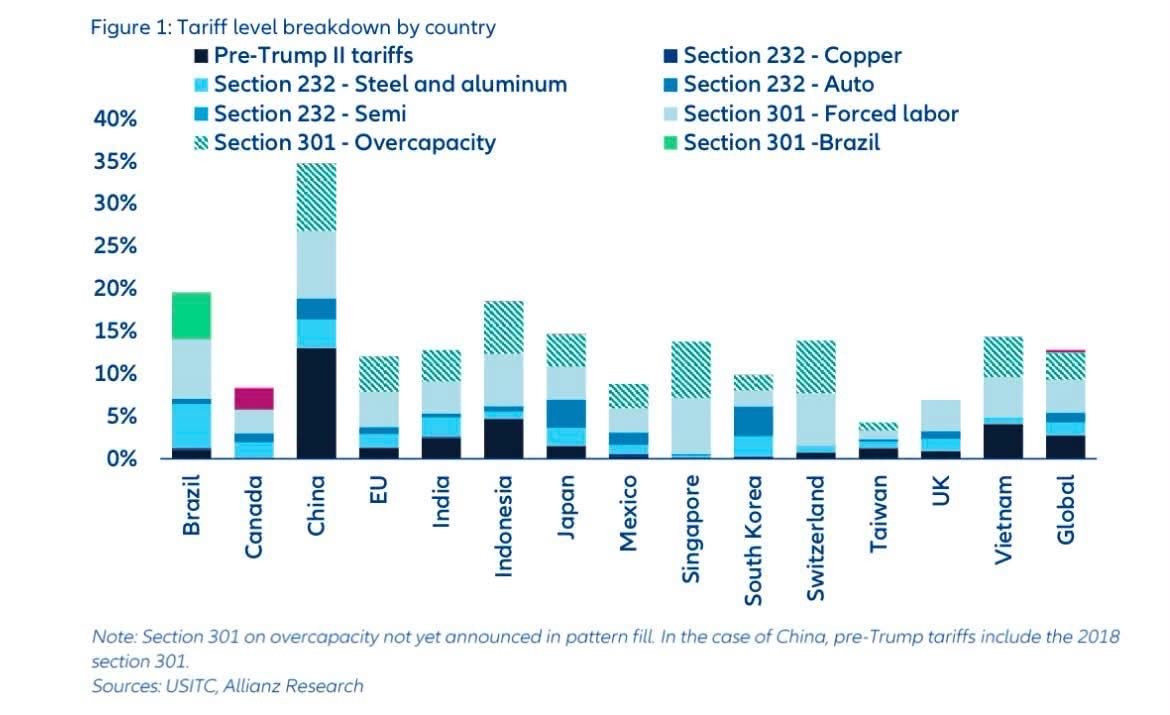
Allianz Research estimates that the average effective tariff on Vietnamese goods entering the United States could rise to about 15% under the broader Section 301 structure, compared with roughly 7% under the Section 122 regime in place before July 24. Its model projects Vietnam’s export losses at around USD6.1 billion in 2026. This estimate covers the wider tariff environment and should not be interpreted as damage caused solely by the forced-labor measure.
FIVE IMMEDIATE PRIORITIES FOR BUSINESSES
Companies should verify HTSUS codes and exemptions; map suppliers down to raw-material tiers; add forced-labor prohibitions and audit rights to contracts; standardize traceability records covering payroll, working hours, recruitment and input origin; and build pricing, Incoterms, sailing-schedule and inventory scenarios for full application of the 12.5% duty. Any final assessment must be based on the specific product and its supporting documentation.
SUPPLY CHAINS MUST PROVE, NOT MERELY PROMISE
The most consequential impact is not simply the additional duty. It is the requirement to demonstrate supply-chain integrity through verifiable data. A supplier code of conduct, an ESG pledge or a stand-alone certificate will carry limited weight if a company cannot identify the origin of materials, labor recruiters, subcontractors and outsourced processing stages.
For logistics providers, the role expands from transportation to management of trade evidence. Shipment files need to connect certificates of origin, product codes, factories, supplier lists and labor due-diligence records. U.S. importers may demand broader data access, audit rights and tax indemnities when discrepancies arise. Risk-allocation clauses and responsibility for evidence should be renegotiated with greater precision.
At the policy level, Vietnam should strengthen mechanisms that prevent goods linked to forced labor from entering or transiting its supply chains, while developing shared traceability standards for businesses, customs authorities, industry associations and international partners.
Tariffs may change through negotiations or reviews, but the integration of labor responsibility into trade policy is unlikely to reverse. Vietnam’s challenge is not merely to absorb additional cost, but to turn traceability, supplier governance and worker protection into competitive capabilities. As “labor-clean goods” become a passport to market access, transparent supply chains will become core infrastructure for international trade.
References: USTR, “USTR Takes Action in Forced Labor Section 301 Investigations” and Federal Register Notice, July 23, 2026; USTR Fact Sheet, July 2026; Allianz Research, “Trade war 3.0: A new, lasting tariff wall”, July 22, 2026.