
.png)
.png)
The Guangzhou Young Entrepreneurs Training Program was launched in 2013 under the leadership of the Guangzhou Youth League. To date, it has trained 783 young entrepreneurs, including representatives of nearly 60 listed companies, 172 nationally recognized high-tech enterprises, and more than 300 national-level science and technology SMEs. The delegation's decision to choose Ho Chi Minh City as the destination for the program's first overseas market survey reflects the growing interest of Guangzhou's young business community in Vietnam's investment and business environment, as well as in the connectivity capacity of the country's southern region.
A Meeting Driven by the Real Needs of Businesses
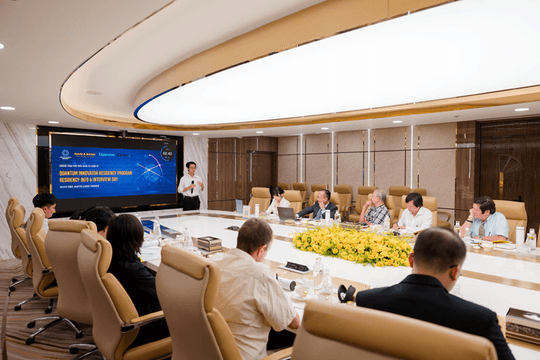
The meeting took place in an open, substantive, and highly connective atmosphere. On the opening screen, the welcome message for the Guangzhou Young Entrepreneurs Delegation was displayed in both Vietnamese and Chinese, reflecting the Vietnamese side's thoughtful preparation and warm regard for an international exchange at the level of the business community.
Attending the program from the Vietnamese side were Dr. Le Van Hy, President of IILS and Vice Chairman cum Secretary-General of HCM-SME; Mr. Nguyen Xuan Phuc, Vice President of IILS cum General Director of U&I Logistics; Mr. Tran Huu Hoa, Director of IILS cum Director of Navitic Technology Company; Dr. Truong Gia Bao, Vice Chairman cum Secretary-General of VIREA; Mr. Chau Minh Chinh, Chairman of the Agriculture, Food, and Green Health Business Association (Green HCM-SME), along with many Ho Chi Minh City enterprises operating in logistics, technology, industrial real estate, trade, agriculture and food, and business support services.
The Guangzhou delegation was led by Ms. Zhu ZhongXia, General Director of Guangdong Luri Environmental Technology Co., Ltd. The list of delegates revealed the notable diversity of Guangzhou's young enterprises, covering environmental technology, commercial supply chains, arts education, construction, Internet technology, intellectual property, property management, smart equipment, smart furniture, artificial intelligence, and legal services.
What made the meeting noteworthy was not only its welcoming protocol, but also the way both sides went directly into the issues that businesses were genuinely concerned about: Vietnam's investment environment, the cooperation potential between Ho Chi Minh City and Guangzhou, supply chain connectivity, human resource development, technology adoption in logistics, the greening of production and business activities, and the role of associations and research institutes in translating market needs into concrete cooperation opportunities.
Ho Chi Minh City in the Vision of Regional Supply Chain Connectivity
Speaking at the program, Dr. Le Van Hy emphasized that Ho Chi Minh City is not only Vietnam's largest economic hub, but also an important node in Southeast Asia's trade network. In his capacity as President of IILS and Vice Chairman cum Secretary-General of HCM-SME, he noted that meetings of this kind carry significance beyond a conventional exchange.
.png)
.png)
According to him, IILS can serve as a platform connecting knowledge, businesses, and markets. As global supply chains continue to be restructured, Vietnamese enterprises need to strengthen management capabilities, standardize operations, apply data, develop human resources, and proactively expand international cooperation. Conversely, Guangzhou enterprises, especially young companies in environmental technology, AI, trade, construction, and supply chains, can find in Vietnam a dynamic and promising market that is rapidly modernizing.
.png)
.png)
.png)
.png)
From Industrial Real Estate to Green Technology and AI
One of the topics that drew considerable attention at the meeting was cooperation in industrial real estate and production-serving infrastructure. Dr. Truong Gia Bao, Vice Chairman cum Secretary-General of VIREA, noted that as capital flows and supply chains continue to shift, Vietnam needs not only industrial land, but also a full ecosystem of supporting services, including logistics, warehousing, legal services, human resources, technology, energy, and environmental standards.
.png)
.png)
The diversity of the Guangzhou delegation also gave rise to a broad discussion. Enterprises in the environmental sector can explore opportunities in waste treatment, green technologies, and energy-saving solutions; AI and smart equipment companies can connect with the growing demand for automation in manufacturing, warehousing, trade, and operations management; while enterprises in intellectual property, legal services, and cultural communications can support market expansion, brand protection, and cross-border communication activities.
.png)
.png)
Young Entrepreneurs, Green Cooperation, and Long-Term Development Thinking
A notable point of convergence between the two sides was the spirit of young entrepreneurship and a shared orientation toward sustainable development. As markets increasingly emphasize green standards, traceability, social responsibility, and transparent governance, Vietnam-Guangzhou cooperation cannot rest only on low costs or traditional manufacturing advantages. What is needed instead is the joint development of new business models in which technology, logistics, environmental standards, and human resource capabilities become core competitive factors.
.png)
.png)
From the perspective of economic journalism and communication, the meeting on the morning of May 26 also highlighted the increasingly important role of intermediary organizations such as research institutes, business associations, and specialized chapters. In many cases, enterprises do not lack goodwill for cooperation; rather, they lack reliable information, focal points for connection, and adequate understanding of regulations, business culture, and market structure. Well-organized exchange programs can help shorten that distance.
The meeting concluded in an open spirit, with many suggestions for maintaining communication channels, building a concrete list of cooperation needs, matching enterprises by sector, and moving toward survey activities, thematic seminars, or short-term training programs on logistics, supply chains, digital transformation, industrial investment, and green development.
From a meeting between young Guangzhou entrepreneurs and organizations and enterprises in Ho Chi Minh City, what remained was not merely the handshakes or formal greetings. More importantly, it was a signal of a new generation of enterprises: proactive in exploring markets, open to international cooperation, and attentive to technology, the environment, human resources, and long-term value chains. In this current of integration, Ho Chi Minh City has the opportunity to be not only an investment destination, but also a place where new business linkages between Vietnam, China, and the wider region can begin.
.png "GELS 2026: When Logistics Steps Out from Behind the Spotlight of Global Events")