An AI agent can monitor a shipment, detect an exception, search for alternative capacity, rebook transport, update the ETA and notify customers. Yet the more authority an organization gives software to act, the more important a fundamental question becomes: which decisions should be delegated to machines, and which must remain with people?
How is it different from predictive AI?
For years, AI in supply chain management has mainly been used to predict and support decisions: forecasting demand, identifying potential shortages, optimizing routes, detecting anomalies or recommending inventory levels. A person usually remained the final execution layer - reading an alert, weighing options, opening another system, emailing a carrier and then making the change. Agentic AI alters the gap between knowing and doing. An AI agent can receive a goal, observe current conditions, reason about the next step, call enterprise tools or APIs, execute a task and check the result before deciding what to do next.
McKinsey describes this shift as moving from analytical AI - “show me the data” - toward agentic AI - “do it for me.” In procurement, agents can analyze supplier information, monitor market indices, compare bids, prepare negotiation strategies and track performance after award. In logistics, the same logic can extend across transportation management systems (TMS), warehouse management systems (WMS), ERP platforms, carrier networks and external data on weather, ports, traffic or customs.

Crucially, agentic AI does not automatically mean fully autonomous AI. A system can operate at several levels of authority: observe only; recommend an action; prepare an action for human approval; or execute independently when transaction value, risk and exception severity remain within predefined limits. The real value is therefore not the removal of people, but the reduction of decision latency between the moment a signal appears and the moment the supply chain responds.
From alerts to action: booking, rerouting and exception management
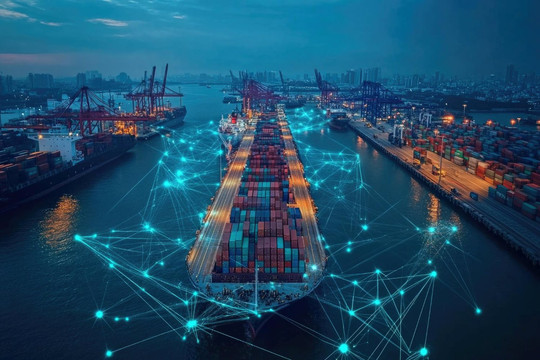
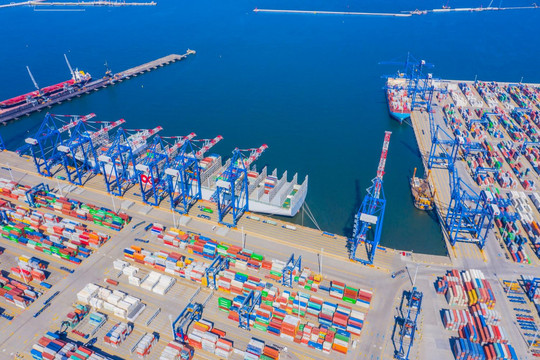
Consider a container that is likely to miss a connection because a transshipment port is congested. A conventional system may generate an alert and wait for an operator. A well-designed agent can go further: identify the orders affected, classify them by priority, check alternative sailings or air capacity, compare space and cost, calculate revised ETAs, and rebook within a budget already approved by the company. It can then update the TMS, notify the receiving warehouse and prepare customer communications.
Rerouting provides another example. When severe weather, a border closure, capacity shortages or a warehouse disruption invalidates the original plan, an agent can compare multiple responses: change the trucking route, switch gateways, split a shipment, expedite the most critical portion or defer lower-priority orders. Google Cloud argues that logistics competition is shifting from pure price optimization toward intelligent orchestration. SAP, meanwhile, has introduced 2026 supply-chain agents designed to detect picking and packing problems, maintain material reservations and coordinate corrective action in logistics execution.

Exception management may be where agentic AI creates its largest operational impact. Supply chains rarely suffer from a lack of data; they often suffer from a delay between signal and coordinated response. One late order can affect inventory, production, delivery schedules, customer commitments and cash flow. If specialized agents can share context - a transportation agent, inventory agent, procurement agent and customer-service agent - the organization can move from “each function handles its own piece” toward near-real-time cross-functional coordination.
Multi-step automation, however, is only as dependable as the business context behind it. An agent that misunderstands an SKU, Incoterms, credit limits, cut-off times, rate agreements or customer priority can make a decision that is fast but wrong. In an agentic environment, master data quality, access controls, business logic and traceability are no longer back-office IT concerns; they become core operating conditions.
Delegate to AI the repetitive tasks that rely on clear data, measurable rules and reversible actions: monitoring ETAs, checking transport schedules, preparing bookings, updating statuses, classifying exceptions or acting automatically within approved cost thresholds. Do not grant open-ended authority over contract signing, supplier creation, regulatory declarations, dangerous-goods decisions, payment-term changes or major customer commitments. The higher the level of autonomy, the clearer the boundaries of accountability must become, including who owns the decision when an agent acts incorrectly.
Governance must come before autonomy
When AI only generates a report, an error may stop at a bad recommendation. When AI can book transport, release a purchase order, reroute freight or communicate a delivery commitment, an error can immediately become a cost, a contractual obligation or a compliance problem. Governance therefore needs to be designed before, or at least alongside, autonomy rather than added after the system is already operating.
A practical governance model starts with an “action authority matrix”: what data each agent may read, which tools it can use, how much it may spend, which fields it may change, and when it must escalate to a person. High-impact decisions - signing or changing contractual terms, onboarding a new supplier, making legal declarations, handling dangerous goods, accepting a major penalty, or changing strategic customer commitments - should have explicit approval points. Repetitive, high-volume, low-risk tasks with clear quantitative rules are more suitable for deeper automation.
NIST emphasizes clearly defining human roles and responsibilities in overseeing AI, alongside qualities such as safety, security, resilience, transparency and accountability. In logistics, that can translate into tamper-resistant action logs, agent identity controls, role-based permissions, human-in-the-loop review for material exceptions, sandbox testing, alerts when limits are exceeded and an emergency stop mechanism when agent behavior no longer matches policy.

A useful principle is to expand authority in stages. Start with an agent that observes and recommends; then allow it to execute reversible actions; only later extend autonomy to financial transactions or external commitments after the system has demonstrated reliable performance across enough scenarios. This staged approach turns agentic AI from a technology demonstration into a governed operating capability.
Agentic AI could become one of the most important shifts in supply-chain digitalization since companies moved from spreadsheets to integrated enterprise platforms, because it reaches directly into the action layer rather than remaining in the information layer. Yet the advantage will not belong to the company that gives AI the most authority. It will belong to the company that designs the right boundary between machine speed and human accountability: where agents may act immediately, where approval is mandatory, and where autonomy must stop. In logistics, autonomy creates value only when it is paired with control.