Arrow Supports EMASS in Expanding Ultra-Low-Power Edge AI

By Thu Le|30/10/2025 21:06

(VLR) Arrow Electronics and EMASS - respectively a global technology solutions provider and a semiconductor company focused on edge AI have announced a partnership to accelerate the deployment of ultra-low-power edge AI solutions for wearables, industrial IoT, and smart-sensing systems, built on EMASS’s ECS-DoT SoC.

Leveraging Arrow’s global engineering prowess, product-design capabilities, supply-chain services, and integration support, EMASS offers ready-made, sensor-integrated edge AI solutions that help technology customers adopt ultra-low-power AI quickly and efficiently.

Technology foundation

EMASS - a subsidiary of Nanoveu Ltd (ASX: NVU) - develops ultra-low-power AI SoC solutions for edge computing. The ECS-DoT SoC enables real-time, always-on intelligence at milliwatt-level power directly on the device, reducing reliance on cloud processing and cutting latency for the next generation of on-device AI applications.

Mark Goranson, CEO of Semiconductor Technologies at Nanoveu, said: “At EMASS, we see a major opportunity to redefine how edge AI empowers devices across industries. Partnering with Arrow helps bring ECS-DoT technology to market faster and supports developers in creating always-on AI applications that were previously impossible at such low power. This partnership positions us to lead the edge-AI ecosystem and accelerate the adoption of real-time, on-device intelligence worldwide.”

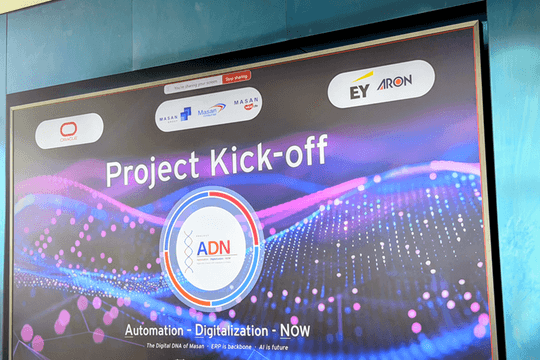
arrow-amp-emass-photo-at-switch.jpg
Arrow - EMASS drive ultra-low-power Edge AI with the ECS-DoT SoC

Dr. Raphael Salmi, president of Arrow Electronics’ components business for South Asia, Korea and Japan, added: “We’re excited to collaborate with EMASS to bring edge AI where it matters most - on the device, in real time, and with minimal power. With Arrow’s global reach, technical expertise, and strong distribution network, combined with EMASS’s deep ties to OEMs and system integrators, we’re uniquely positioned to expand market reach and capture new opportunities in AI SoCs.”

Expanding the edge-AI ecosystem

Arrow and EMASS will co-develop SDKs, developer tools, and reference designs, and co-promote them through Arrow’s technology network and industry programs to speed time-to-market for ultra-low-power AI ideas. The collaboration also taps into technical resources at the NTU-Arrow Invent Lab to accelerate innovation, enabling developers to prototype edge-AI applications more quickly with joint tools and training.

Arrow and EMASS have just showcased joint evaluation boards and reference designs at Singapore Week of Innovation and Technology (SWITCH), held October 29 - 31, 2025. These tools are designed to accelerate development and deployment of ultra-low-power edge-AI solutions across a wide range of use cases.

Bài liên quan

(0) Bình luận
  • Port concessions and investment responsibilities
    Granting a business the right to operate a port can mobilize capital and operational expertise. The outcome depends on identifying who invests, who maintains the assets and who is accountable when infrastructure deteriorates or services are interrupted. A sound agreement connects operating rights with specific obligations and protects customers' ability to use the port throughout the operating term.
  • Measuring shipment emissions across the transport chain
    A shipment may move through trucks, ports, vessels and several transfer points before reaching its consignee. Quantifying the emissions associated with that journey requires an agreed boundary, suitable data and a clear allocation approach. A useful result should explain how it was calculated. That transparency allows customers to compare transport options and helps operators identify where better information or operational changes would have the greatest value.
  • Prefabricated Housing and Delivery in Construction Sequence
    Prefabricated housing moves part of construction from the site to the factory, but installation progress still depends on how components are delivered. Correct quantities cannot sustain work when an item needed first arrives later, or when the site is unprepared to receive it. For residential projects, transport planning should start from the approved erection sequence, connecting production schedules with unloading capacity and the installation position of each component.
  • Managing Returns in Domestic E-commerce
    A returned parcel is not a closed case. The customer’s request still needs a decision, while each item needs an authorized destination and an accurate stock status. When parcels reach a warehouse but wait unexamined, both merchandise and money remain tied up between processes. For domestic e-commerce, returns should be designed as part of normal operations, with clear ownership from the initial request to the final inventory and financial entries.
  • Vessel time in port and how to interpret terminal productivity
    A terminal can handle containers quickly while a vessel still waits a long time before being accepted, or remains alongside after cargo operations have finished. Productivity assessment therefore needs to cover the sequence of services provided during a call. Separating waiting from cargo handling, checking measurement units and comparing similar operating conditions helps ports and carriers identify what needs improvement.
  • Electric trucks and the total cost of fleet ownership
    Electric trucks can lower energy expenditure, but a purchase decision needs to consider the full period of vehicle use. Acquisition cost, charging infrastructure, carrying capacity and completed trips all influence the result. For Vietnamese operators, a sound business case starts with the transport assignment and fleet records. The vehicle model should follow that assessment, supported by an operating plan that can deliver the required service consistently.
Nổi bật Tạp chí Vietnam Logistics Review
Đừng bỏ lỡ
Arrow Supports EMASS in Expanding Ultra-Low-Power Edge AI
POWERED BY ONECMS - A PRODUCT OF NEKO