As supply becomes concentrated in a limited number of countries and export controls expand, logistics must learn to manage cargo flows that are light in weight but capable of disrupting entire industries.
Small supply chains can support enormous downstream value
The IEA's Global Critical Minerals Outlook 2026 shows that demand for critical minerals remains strong across all scenarios. By 2040, total demand could almost double; lithium demand rises more than threefold, while nickel, graphite and rare earth demand grows by roughly 50-90%. Growth is being driven not only by electric vehicles and batteries but also by power grids, semiconductors, AI, robotics, aerospace and defence.
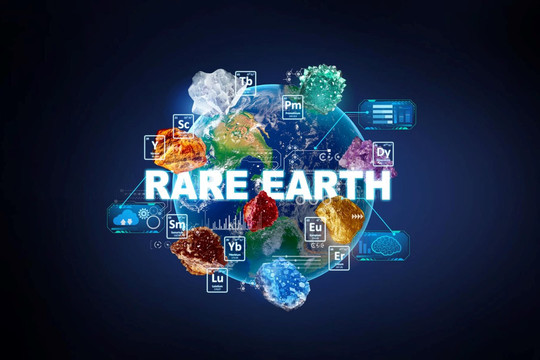
The key point is that risk is not proportional to tonnage. Gallium is used in semiconductors, germanium in fibre optics and optoelectronics, yttrium in high-temperature coatings, and magnet rare earths in electric motors. Their markets are much smaller than those for steel or oil, yet the absence of one material can prevent a much more valuable finished product from being manufactured.
The IEA estimates that full implementation of expanded rare-earth controls could put around USD 6.5 trillion of annual downstream production outside China at risk. A complete disruption of battery-grade graphite trade could expose more than USD 300 billion of downstream production each year. These figures do not imply that all of that value would be lost; they illustrate how much industrial activity can depend on relatively small material flows.
This changes the way companies should think about inventory. A high-value container of components may have several alternative suppliers, while a few tonnes of specialised refined material may take months to replace. Supply assurance should therefore be measured not only in dollars per tonne, but also in the cost of a production line stopping when the material fails to arrive.
The risk is often in refining, not only in mining
The highest concentration in critical-mineral supply chains is often found in refining and processing rather than at the mine. The IEA reports that concentration among leading refiners continued to rise for most energy minerals in 2025. China is the dominant refiner for many materials, while Indonesia is the leading player in nickel. For gallium, graphite, manganese and rare earths, the top refining country accounts for more than 90% of global supply.
This explains why opening a new mine does not automatically create an independent supply chain. Lithium ore must be converted into battery-grade chemicals; natural graphite must be purified and shaped; rare earths must be separated, refined, converted into metals and alloys, and eventually manufactured into magnets. Each step requires different equipment, process knowledge, chemicals, quality systems and skilled operators.
The IEA finds that mining projects outside dominant suppliers are expanding faster than midstream and downstream capacity. In rare earths, announced refining capacity in geographically diversified regions is equivalent to around two-thirds of expected mined supply by 2035, while planned magnet production represents only about one-third. The gap between the mine and the finished industrial input is where a large share of supply-chain risk accumulates.

Recent trade restrictions have made that risk operational. The number of mineral tariff codes covered by Chinese export controls has increased sharply since 2023; the Democratic Republic of the Congo has introduced cobalt export quotas, while Zimbabwe and Mozambique have applied restrictions to selected lithium and graphite flows. For logistics teams, a policy change can quickly turn a stable route into one that requires licensing, new ports, alternative suppliers or higher safety stocks.
Strategic-mineral management therefore needs a multilayer map: where the ore is mined, where it is refined, which technologies are concentrated, which transport corridors depend on a single gateway, and which materials have few viable substitutes. Without that map, companies can mistake diversified mining for genuine supply-chain diversification.
Strategic minerals have an unusual characteristic: small physical volumes can lock up enormous downstream value. A few tonnes of battery-grade graphite, magnet rare earths or gallium can determine whether millions of dollars of finished products are completed. The critical KPI is therefore not only purchase price per tonne, but also supplier concentration, replacement lead time, safety-stock coverage and the economic loss created when the material fails to arrive on time.
Diversification requires technology, inventory and logistics
Major economies are moving away from a pure “buy from the cheapest source” model toward layered supply security. The EU's Critical Raw Materials Act sets 2030 benchmarks of 10% for domestic extraction, 40% for processing and 25% for recycling, while aiming to keep dependence on any single third country below 65% at each relevant processing stage. The framework makes clear that diversification must extend across the value chain, not stop at mining.
Strategic stockpiles are returning as another risk-management tool. For materials with small markets, long lead times and limited substitutes, several months of inventory can cost far less than an industrial shutdown. But stockpiling cannot be applied uniformly: some chemicals have storage requirements, material quality can degrade, prices fluctuate and working capital is tied up. Inventory policies need to reflect criticality rather than commodity value alone.
Recycling is a third layer of resilience. The IEA expects secondary supply to increase its contribution across key energy minerals from around 10% today to close to 20% by 2040. Yet recycling itself remains highly concentrated: China accounts for more than three-quarters of global battery pre-treatment capacity and around 90% of material-recovery capacity. Building circular supply chains therefore still requires technology, collection networks and reverse logistics.
For Vietnam, the trend creates both opportunity and a higher bar for execution. Policy directions announced in 2026 place rare earths, semiconductor materials, battery and energy-storage materials among priority sectors and emphasise deep processing rather than the export of raw resources. Work on a national rare-earth strategy also points toward an integrated chain from extraction through processing and industrial use.
Resource endowment is only the starting point. Ports, specialised warehouses, dangerous-goods transport, dust and moisture control, traceability, chain of custody, cargo security and project logistics for processing plants all become part of the equation. The smaller the physical volume of a strategic mineral, the more precise logistics must become in quality control, documentation and timing.
The competition for strategic minerals is exposing a fundamental principle of modern supply chains: the material that weighs the least can sometimes determine the most production. The value of a mineral is not simply the number of tonnes moved, but the number of industries that depend on it.
Resilience therefore cannot be built by buying more material alone. It requires diversified sources, processing capability, selective inventories, recycling and logistics visibility from mine to factory. When a small material flow can hold up a much larger value chain, managing strategic minerals becomes a form of industrial risk management.