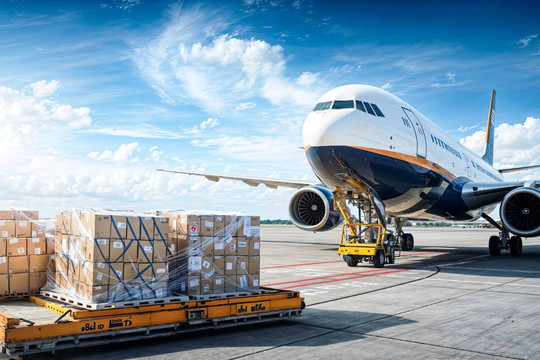

The explosion of online orders and disruptions in ocean shipping are the two decisive factors behind this. Global e-commerce is estimated to reach 6.3 trillion USD in 2024; roughly 80% of cross-border orders already travel by air, and that share is likely to rise as buyers get used to “click today, receive in 2–3 days.” But even in the midst of this surge, the market is clearly entering a “post-bubble” phase, with sharp divergence between lanes and between regions.
E-commerce growth is no longer a one-way climb
One notable signal since early 2025 is that e-commerce air-cargo indicators are no longer shooting straight up as they did in the previous two years. FreightWaves’ analysis shows that in the first seven weeks of 2025, overall air cargo demand was almost flat compared with the same period in 2024, even though rates remained relatively high because of capacity constraints. In its 2025 outlook, IATA also warns that demand growth will slow markedly after the record year of 2024, mainly because the global economy is cooling and bellyhold capacity on passenger flights is gradually returning.

The world’s largest e-commerce air corridor - China to the US is being hit particularly hard. The US decision to effectively end “de minimis” tax exemptions for low-value parcels from China has pushed down volumes of small packages from platforms like Shein and Temu; in May 2025 alone, air-cargo demand from Asia to North America dropped by more than 10%, while low-value e-commerce shipments plunged by 43% compared with the previous month. Earlier, experts estimated that China–US e-commerce flows accounted for roughly half of eastbound capacity on this lane and around 6% of global air-cargo demand. When such a major “tap” is turned down, the market is forced to rebalance.
The race to build new hubs and sortation centers in Southeast Asia and across Asia
Even though growth is slowing on some routes, e-commerce is still seen as the main long-term driver of the industry. IATA’s report on the future of air-cargo infrastructure stresses that e-commerce-related shipments could grow by an average of 14% per year through 2026, forcing airports and airlines to redesign cargo terminals, deploy automation and sorting robots, and process data in real time. Another analysis shows that the express segment is expected to account for up to 25% of total air-cargo volume by 2043, up from around 18% today - largely thanks to demand for e-commerce distribution.
When low-value flows from China to the US are constrained, carriers and merchants do not simply “shut down”; they redirect. Many orders are being reallocated to Europe, the Middle East, Latin America and, especially, Southeast Asia—a region with a young population, a rapidly growing middle class and a high propensity for cross-border online shopping. This is triggering a race to establish new e-commerce hubs and sortation centers in Vietnam, Thailand, Malaysia, Indonesia, India and beyond. Express operators, integrators and 3PLs are leasing more warehouse space around airports, investing in automated sortation lines and adopting cross-border fulfillment models (“ship from hub”) instead of merely handling last-mile delivery.
Significantly, reports from Boeing and other research bodies point out that increasingly multi-node supply chains depend on air cargo to connect stages of production, assembly and finalization - not just the final distribution step. This opens up room for Asian hubs to act as intermediaries, handling both e-commerce flows and shipments of parts and semi-finished goods that are “circulating” across multiple countries.
New strategies for airlines, express operators and 3PLs: living by data, not just by lift
In this “post-bubble” context, the winners are no longer those who simply hold the most aircraft or the most slots, but those who can read and act on data best. As e-commerce flows to the US decline, many Asian airlines have quickly cut back freighter frequencies across the Pacific and redeployed aircraft to Europe, the Middle East or intra-Asia, where growth potential remains. More agile operators have started offering hybrid products: combining long-term block-space agreements with flexible allotments for e-commerce platforms, applying dynamic pricing by day and even by specific departure and arrival time windows.

For express carriers and 3PLs, strategy is also shifting from “buy more lift” to network optimization. Many companies are rolling out digital-twin systems to simulate different scenarios: consolidating volumes through a new hub, changing the connections between two hubs, or separating e-commerce flows from traditional general cargo. Some technology-savvy players are even selling network-management solutions directly to their customers—major e-commerce marketplaces - thus moving from being mere “carriers” to becoming supply-chain advisors and partners.
For Southeast Asian logistics companies, this is a “narrow but bright” window. If they continue to rely solely on spot contracts and traditional operating models, they will easily be dragged into a race to the bottom on rates, with ever-thinner margins. In contrast, those who invest seriously in order-management systems, route-data tracking and integration with e-commerce platforms for demand forecasting can carve out positions in higher-margin niches such as cross-border fulfillment, regional inventory management or fast delivery solutions (D+2, D+3) to multiple countries at once.
Recent forecasts from IATA and aircraft manufacturers converge on one point: e-commerce and express will be the biggest growth engines for air cargo over the next 20 years. Global e-commerce is estimated at 6.3 trillion USD in 2024 and could approach 7 trillion USD by 2025–2026. Express currently accounts for around 18% of air-cargo volume but may rise to 25% by 2043, as more consumers are willing to pay extra for speed and real-time shipment tracking. That outlook guarantees a “long runway” for those who manage to stay in the game after the current adjustment phase.
The e-commerce “bubble” is not bursting; it is simply deflating enough to make the market more grounded in fundamentals. The routes and regions that benefited most from the initial wave - such as China to the US - will have to cede part of their share to emerging markets. In this broader picture, Southeast Asia and many other Asian countries are facing a rare opportunity to climb to a higher rung in the logistics value chain. Those who control the data, the hub networks and the ability to design services tailored to specific industries will become the ultimate winners on the e-commerce air-cargo “runway” of the next two decades.
.jpg "Asia–Pacific Leads the Pack: A New Air Cargo Boom After the Pandemic")


.jpg "Scope 3: From “Unmeasurable” to “Action-Led Management”")
.png "Fulbright at 30: Homecoming… and the Next Steps Toward New Horizons")