
(Vietnam Logistics Review) It is still early to talk about the future of TPP. However, it is not too early to discuss and prepare policies for post- TPP era, in case TPP is dead.
A less sanguine perspective
Trans Pacific Partnership Agreement (TPP) is one of bi-lateral and multi-lateral agreements Vietnam has signed in the last two years. It is widely mentioned for the scale- 12 country members account for 40% GDP of the world’s and for great expected benefits it will bring to the economy of Vietnam- an economy with signs of stagnation and crisis.
However, the “fate” of TPP became uncertain after the U.S.’s presidential election. On November 21st, the newly-elected Donald Trump announced the first thing to do was to pull out of the TPP deal. The Congress also announced to withdraw TPP from its agenda.
What happens if the U.S does not take part in TPP? As agreed, TPP only comes into effect when there is participation from 6/12 countries, accounting for 85% GDP and it is approved by February 2018. Statistics show the US accounting for 62%; Japan, 18%; the rest 10 countries, 20% GDP of the block. It means if there is no the US’s participation, TPP will not come into effect. That is why Japan’s PM Shizo Abe said TPP will become “meaningless” without the US’s participation.
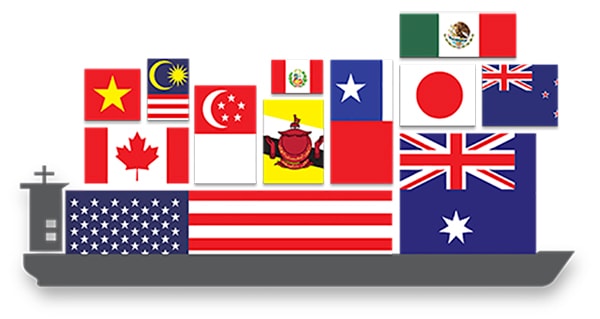
Thus, to January 4th, 2018, if the U.S Government has no change in their ideas, TPP either dies on the vine or will be negotiated again to remove article 30.5 and changed into a completely different agreement. In the meantime, other countries have been pushing the progress of TPP implementation: Japan’s the House of Representatives approved TPP and it is under the House of Councilors’ consideration; New Zealand, Australia, Malaysia, Singapore, and Mexico showed their supports and will approve TPP at the beginning of 2017.
TPP, RCEP and Vietnam
Many now put their expectations on Regional Comprehensive Economic Partnership (RCEP)- the time of post TPP. It started at the East Asia Summit Conference in November 2012, RCEP is in the 15th round of negotiation and possibly completed in the middle of 2017.
RCEP is planned to include liberalization of goods, services, investments, economic cooperation, technology, intellectual property, competition policies and dispute solving. However, the difference in development levels in ASEAN prevents RCEP from active free trade policies. RCEP’s orientation principles accept different realities in developing countries as Cambodia, Laos, Myanmar and Vietnam and offer flexible solutions. RCEP is to push up economic cooperation and technology to shorten development distance among countries.
RECEP agreement aims to establish a comprehensive partnership between ASEAN and 6 partners, including China, Japan, Korea, Australia, New Zealand and India- countries that ASEAN has signed free trade agreements- also called ASEAN +6. It is the first free trade agreement between Asia and other participating countries. The countries account for half of the world’s population and 30% of the world’s GDP. |
The noticeable difference between RCEP and TPP is the China’s participation as a major member in RCEP and the U.S is a major member in TPP. Many analysts said Vietnam will be beneficial from RCEP. However, Vietnam’s current export to the U.S accounts for 17.9% of GDP, but only 3.8% of GDP to China. Vietnam will also be the worst loser if TPP will not be approved. The sight of tax-free low-price goods from China flooding Vietnam’s market will be the worst nightmare to any local producer.
TPP show the wish to establish a counterbalance to the China’s policy of expanding influence in the fields of economy and politics in Pacific area. TPP surpasses the limit of free trade, putting emphasis on business conditions, labor, and intellectual property principles. To Vietnam, no TPP leads not only to the decrease in export but also to the lack of driving force for innovations in the fields of economy and law.
In the situation, having proper planning and policies is indeed the matter of importance.


.png "Dung Quat Enters a New EPC Execution Phase")