
.png)
.png)
Defining the role of each port cluster on the regional map
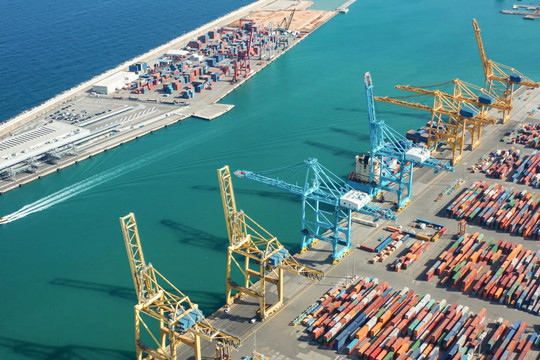
In just a few years, Vietnam’s major container port clusters have appeared more prominently in global rankings. Ho Chi Minh City’s ports now handle over 9 million TEUs per year and sit in the low-20s of global league tables; Hai Phong reaches around 7 million TEUs; and the Cai Mep–Thi Vai (CM–TV) complex is in a similar range and firmly in the world’s Top-30 busiest container gateways. These three hubs are now recognized among the Top-50 container ports worldwide, reflecting Vietnam’s growing presence on the international shipping map.
Placed on a “regional map”, each cluster hints at a different strategic role. In the North, the Hai Phong–Lach Huyen complex is emerging as the export–import gateway for the northern growth triangle and the Kunming–Lao Cai–Hanoi–Hai Phong economic corridor. With the right investments in rail and deep-sea links, it can evolve into a new transshipment and distribution center for the Gulf of Tonkin and southern China’s border trade.
.png)
.png)
Meanwhile, the Ho Chi Minh City port system and terminals along the Saigon–Dong Nai river network continue to play the role of a “traditional powerhouse” for the Southern Key Economic Region, while also serving as a launchpad for new hub concepts such as the planned Can Gio transshipment port. Against that backdrop, many experts argue that the key is no longer to let each locality “race to dredge channels” or expand in isolation, but to clarify the functional profile of each cluster: which one focuses on international transshipment, which one serves as the main export gateway, and which one specializes in value-added logistics and intra-regional distribution.
A clearer division of roles would help Vietnam avoid self-cannibalization, where local ports primarily compete against each other with fees and short-term incentives while the real market lies in regional supply chains linking ASEAN, the Indian Ocean and the Pacific. Having three port clusters in the Top-50 is only the starting point; the next step must be to “upgrade the role” of each cluster within the broader logistics landscape of ASEAN and the Indo-Pacific.
Hinterland connectivity: from roads to rail and inland waterways
No matter how modern a seaport is, it will struggle to reach its full potential if it is backed by a “bumpy” hinterland network. Total cargo throughput across Vietnam’s seaport system is now in the hundreds of millions of tons annually, and container volumes approach 30 million TEUs. As more supply chains shift toward Vietnam, these figures are likely to climb further, putting considerable pressure on the transport corridors linking ports with industrial zones and production areas.
In reality, not a few port clusters are “choked” by overloaded access roads, a lack of truck parking and staging areas, or insufficient inland container depots (ICDs) to absorb flows. In the North, the corridor from Lach Huyen–Hai Phong to Hanoi and the surrounding industrial provinces still relies heavily on road transport while rail and inland waterway links have yet to reach their full potential. In the South, even as expressways and ring roads are developed, congestion on key port access routes continues to occur, especially during export peaks and seasonal rush periods.
In this context, the concept of the port hinterland needs to shift decisively toward a multi-modal corridor model. Roads will remain the backbone, but their load should be shared by dedicated rail connections to ICDs and well-developed inland waterway routes along the Red–Thai Binh river system in the North and the Dong Nai, Saigon, Tien and Hau rivers in the South.
.png)
.png)
In parallel, upgrades to dry ports and international intermodal rail terminals, co-located with industrial parks and domestic logistics centers, would “relocate” customs clearance, inspection and consolidation activities closer to the cargo source. The model of “inland clearance, coastal loading” allows customs and inspection to be performed inland, with sealed containers then moved efficiently to deep-sea gateways. This shortens the distance trucks must travel to the seaport, reduces congestion in port urban areas, and helps carriers and terminal operators plan stowage and operations more scientifically. With strategic initiatives such as the Kunming–Lao Cai–Hanoi–Hai Phong corridor or improved links between Cai Mep–Thi Vai and Long Thanh International Airport, Vietnam’s port clusters can realistically evolve into strategic nodes in regional and intercontinental networks.
Value-added services: logistics parks around ports will determine their pull
As berth infrastructure and handling tariffs across the region gradually converge, the true differentiator for seaports is no longer the length of the quay or the depth of the channel, but the strength of the surrounding service ecosystem. Shippers, retailers and major carriers want to call at ports where bonded warehouses, cold storage, light manufacturing and labeling, kitting and consolidation, and regional distribution centers are readily available within a short radius.
Looking at Cai Mep–Thi Vai, many analysts believe the complex has so far tapped only part of its potential. Its ambition to become a major international transshipment hub will be hard to achieve if bottlenecks in connectivity, distribution centers, empty container depots, truck yards and dry ports are not addressed decisively. A similar situation exists around Ho Chi Minh City and Hai Phong, where a truly large-scale, modern “service ring” is still missing – a ring that could both capture transshipment flows and support a full suite of value-added logistics services.
The “logistics park” model is emerging as a best practice worldwide: within a single integrated zone, one finds dry warehouses, cold stores, bonded facilities, container yards, ICDs, customs services, regional distribution platforms and even control towers for supply chain management. With relatively diverse land banks still available around key ports, provinces such as Ba Ria–Vung Tau, Hai Phong, Ho Chi Minh City or Dong Nai are well-placed to plan early and court the right investors. If successfully developed, port-centric logistics parks could become Vietnam’s “trump card” for competing with the likes of Singapore, Laem Chabang or Klang in attracting ocean carriers and global distributors to base their regional operations here.
.png)
.png)
Restructuring Vietnam’s seaport network in the current wave of global supply chain reconfiguration is not just about adding more berths or dredging deeper channels. It is a national supply chain strategy that demands a consistent vision: clearly defined roles for each port cluster, strong investment in multimodal hinterland corridors and proactive development of port-centric logistics ecosystems. If this is done well, Vietnam will not only climb higher in international port rankings, but more importantly, shift its status from a “pass-through point” to a genuine “destination” in the strategies of manufacturers, retailers and global logistics providers.