
.png)
.png)
New alliances, new networks: How is Vietnam’s port map shifting?
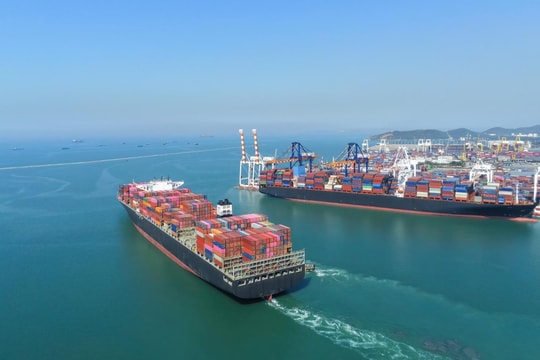
After almost a decade, the 2M alliance between Maersk and MSC officially ended in January 2025. MSC, now the world’s largest carrier, has chosen to sail alone with an East–West network of more than 30 loops, leveraging the large vessels ordered during the 2021–2022 boom. Maersk has taken a different route: partnering with Hapag-Lloyd to create the Gemini Cooperation, built on a hub-and-spoke philosophy with fewer port calls on the mainlines and a greater reliance on hubs and shuttle services.
.png)
.png)
The Gemini Cooperation is being deployed with roughly 290–340 vessels and total capacity of about 3.4–3.7 million TEUs, accounting for more than 20% of global container capacity. The network covers seven major East–West trades with dozens of mainline and regional shuttle services. A key promise is schedule reliability of around 90%, well above the 50–55% averages that Sea-Intelligence recorded for 2024 and early 2025. Behind these figures lies a “fewer ports but more stable” mindset, which directly impacts which ports are chosen as hubs.
By contrast, city terminals such as Cat Lai in Ho Chi Minh City and some northern ports are facing a different challenge: either accepting a more feeder-based role, relying heavily on shuttle services to Cai Mep, Singapore or Port Klang, or working hard to secure a limited number of direct calls from remaining alliances. This will significantly influence total transit time, delay risk and domestic logistics costs for shippers, especially those exporting large volumes to Europe and North America.
Cheaper base rates, rising surcharges: Rethinking total logistics cost in the new era
Alongside alliance restructuring, the market is also grappling with oversupply. Estimates from Alphaliner and other market analysts suggest that in 2025, global container fleet capacity may grow by around 6–7%, while demand is likely to expand only 2–4%. On the Asia–Europe trade, some statistics show volumes in Q2 2025 down by about 7% year-on-year, forcing carriers to increase blank sailings to keep supply in check.
.png)
.png)
The result is downward pressure on base freight rates, while the surcharge structure becomes denser and more volatile. Recent market reports document how spot rates on certain trades have dropped compared with peak years, yet the total cost paid by shippers has not fallen to the same extent because of adjustments to bunker surcharges, canal and war-risk surcharges, congestion surcharges and peak season charges.
On a multi-port coastline like Vietnam’s, carriers optimising networks around a hub-and-spoke model inevitably create a new layer of cost: domestic logistics to “follow” the new hubs and port rotations. Shippers that have relied on the same traditional loop for many years can find themselves caught off guard when port calls are reduced, moved or converted to transhipment, forcing last-minute changes to warehousing, trucking and stuffing plans.
This is why shippers should look beyond nominal ocean freight and calculate end-to-end logistics cost to the buyer’s door, including domestic legs, storage fees and the risk of delay caused by blank sailings or port changes. Sometimes accepting a slightly higher freight rate on a more stable service with a convenient port call may generate lower total cost and risk than chasing the “cheapest but farthest” option that requires an extra transhipment step.
Multi-carrier, multi-lane strategies: How should Vietnamese shippers “spread their eggs”?
Alliance restructuring brings more choice but also more complexity. Since the break-up of 2M, MSC has pursued a strategy focused on scale and network coverage, while Maersk–Hapag-Lloyd, through the Gemini Cooperation, emphasise on-time performance and integrated logistics, targeting schedule reliability of up to about 90%. For shippers, the key question is therefore not only which carrier is cheaper, but which combination of carriers and services best supports their supply chain optimisation.
.png)
.png)
Large importers in Europe and North America are increasingly adopting a multi-carrier, multi-lane approach built around a clear “core”. On each key trade, they maintain longer-term contracts with one or two strategic carriers or forwarders that account for a defined share of their volumes, while the remainder is spread across other providers on shorter, more flexible terms. This helps secure space during peak seasons while retaining the ability to pivot when market conditions change or when disruptions hit a specific port, trade or alliance.
For Vietnamese shippers, especially mid-sized exporters, “spreading the eggs” should start from mapping their flows. Companies need clarity on key markets, volume patterns by trade and by season, and which shipments are time-critical versus those that can tolerate flexibility. Only then can they make informed choices about combining carriers from different alliances, choosing direct or transhipment services, balancing annual and quarterly contracts, and mixing fixed and index-linked or spot exposure, instead of deciding case by case on gut feeling.
Information quality is equally critical. In a post-2025 world where blank sailings and port changes are used as supply–demand management tools, shippers should demand greater transparency from carriers and forwarders about planned network adjustments, with early notice of changes so production and delivery plans can be adapted. Partnering with providers that can deliver near-real-time data, from vessel positions to container status, becomes a competitive advantage rather than a mere “add-on service”.
Ultimately, the 2025 alliance reshuffle should be seen as a reset of the rules rather than a threat. Oversupply gives shippers the chance to negotiate better pricing, but only those who truly understand their own supply chains and build deliberate strategies for contracts and service selection will capture that value. For Vietnamese shippers hoping to ride the current wave of production and trade shifts that are elevating Vietnam’s role in global supply chains, stepping up to a more sophisticated level of logistics management is no longer optional. It is the new minimum requirement to stay in the game.


.png "Logistics Symbiosis – Ecosystem Thinking")
.jpg "Dien Bien, Yunnan and Luang Prabang: Expanding Regional Cooperation and Investment Opportunities")