
.png)
.png)
Fleet growth vs. trade growth: A new cycle locked in by oversupply
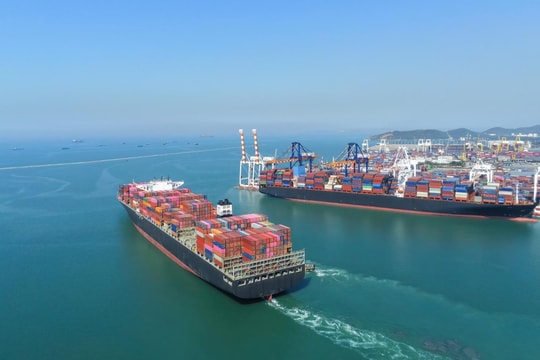
The World Bank’s mid-2025 projections suggest global trade in goods and services may grow by only about 1.8% in 2025, down from 3.4% in 2024. At the same time, Alphaliner and other analysts expect global container demand to expand by roughly 2%, while the container fleet grows by more than 6% this year alone. Some market commentaries point out that the orderbook now represents more than 30% of the active fleet, with average annual fleet growth of 6–7% forecast between 2025 and 2028.
.png)
.png)
On the demand side, the picture is hardly encouraging. A May 2025 Drewry presentation downgraded its 2025 forecast for world container port throughput to a 1% decline, driven largely by newly announced U.S. import tariffs. Various analyst and carrier reports warn that industry profits could fall by more than 80% in 2025 compared with the 2022 peak, as freight rates normalize while operating costs, interest rates and environmental compliance costs remain elevated.
On the capacity side, the story is about structure as much as volume. Data from one fleet analytics platform show that by late 2025, ultra-large container ships (ULCS) account for more than 8 million TEUs across 432 vessels, while the mid-size 5,100–10,000 TEU segment has seen little net capacity growth. In other words, most of the “new metal” entering the market consists of very large ships, forcing carriers to maintain long-haul trunk services and high utilization levels to keep unit costs down, which in turn increases the risk of oversupply on trades where demand is not keeping pace.
Sea-Intelligence’s October 2025 outlook argues that the global container market is shifting back into cyclical overcapacity, with a peak expected in 2027 at levels comparable to the 2016 price wars. Other studies suggest that the supply–demand gap may remain wide until at least 2028, especially if demolition activity stays sluggish and new orders continue at the current pace.
.png)
.png)
Spot vs. contract: Who is steering the new cycle?
Historically, analysts have read the container cycle primarily through spot rate indices such as SCFI or WCI. In 2025, the picture is more nuanced: spot rates are softening but not collapsing as they did in 2015–2016, while contract rates and the charter market are moving out of sync. On 11 December 2025, Drewry’s World Container Index stood at about USD 1,957 per 40-foot container, up 2% week-on-week thanks to Asia–Europe rate increases. Meanwhile, on Asia–US trades, FreightWaves reported weekly spot rate drops of more than 30% as GRIs failed to hold in the face of overcapacity.
On the contract side, Drewry and others highlight a growing disconnect: charter rates remain elevated after a five-year boom, even as freight rates on major trades fall, creating a margin squeeze for carriers. This reflects a structural shift in the market: liner-owned tonnage has increased significantly, reducing charter market liquidity and giving owners more leverage in long-term charter negotiations.
The new cycle is therefore not simply about “spot pulling contracts up or down.” Carriers are deploying a wide toolkit of capacity management measures: blank sailings, service reshuffles, slow steaming and extended round voyages to absorb some of the surplus tonnage. This explains why rates have not fallen straight back to the 2016 lows but instead fluctuate around a new plateau: far below Covid-era peaks, yet still noticeably higher than 2016–2019 averages.
For shippers, the key issue is the asymmetry between spot and contracts. On some trades, spot rates have temporarily dipped below long-term contract levels, triggering pressure to renegotiate. However, relying solely on the spot market to “catch the bottom” is risky: off-season volatility, sudden tariff changes, and disruptions such as Red Sea or Suez events can push rates sharply higher in a short time. The new cycle is less about choosing sides and more about finding the right balance between the flexibility of spot exposure and the security of contracted capacity.
How should Vietnamese shippers behave in a “permanent oversupply” market?
.png)
.png)
First, Vietnamese exporters should develop a clear allocation strategy between spot and contract volumes. One workable approach is to secure 50–70% of volumes on core trades under annual or semi-annual contracts with built-in flexibility (corridor pricing, index-linked formulas) to avoid being stuck with outdated rates when the market turns, while leaving the remainder for spot or short-term deals to capture off-peak opportunities. The exact ratio will depend on each company’s margins, time sensitivity and financial strength.
Second, instead of opportunistically chasing one-off quotes, shippers should establish a basic internal market-intelligence function. Benchmarks from sources such as Drewry, Xeneta, FreightWaves, Sea-Intelligence and Alphaliner can help them understand where their contract rates sit relative to the broader market. At scale, working with digital booking and rate-management platforms alongside trusted logistics partners can bring greater transparency and discipline to freight procurement.
Third, oversupply of vessels does not automatically mean oversupply of quality services. As carriers restructure networks, cut port calls and rely more on transhipment to keep the biggest ships full, the risk of delays, extended transit times and higher inland costs can increase. Shippers need to assess partners not only on price but also on schedule reliability, quality of information, problem-solving capability and financial resilience.
Finally, a “permanent oversupply” environment can also be an opportunity to redesign supply chains. When freight is relatively cheap and predictable, shippers can experiment with new routings, gateway ports, sea–rail or sea–land combinations, or shifting some orders to emerging markets. These decisions should be grounded in data and scenario planning rather than short-term reactions to a few weeks of low rates. If used wisely, this phase of the cycle can allow Vietnamese shippers not only to survive but to upgrade their logistics capabilities and negotiating position in global value chains.
.png "How Will the 2025 Shipping Alliances - Change the game for Vietnamese Shippers?")



.png "Dien Bien builds investment value chains to power its next growth chapter")

.jpg "Dien Bien, Yunnan and Luang Prabang: Expanding Regional Cooperation and Investment Opportunities")